What I look for when supervising a first research project
After supervising one doctoral and three master's theses, the thing I select for is not the thing I expected.
ByÖnder Eyecioğlu
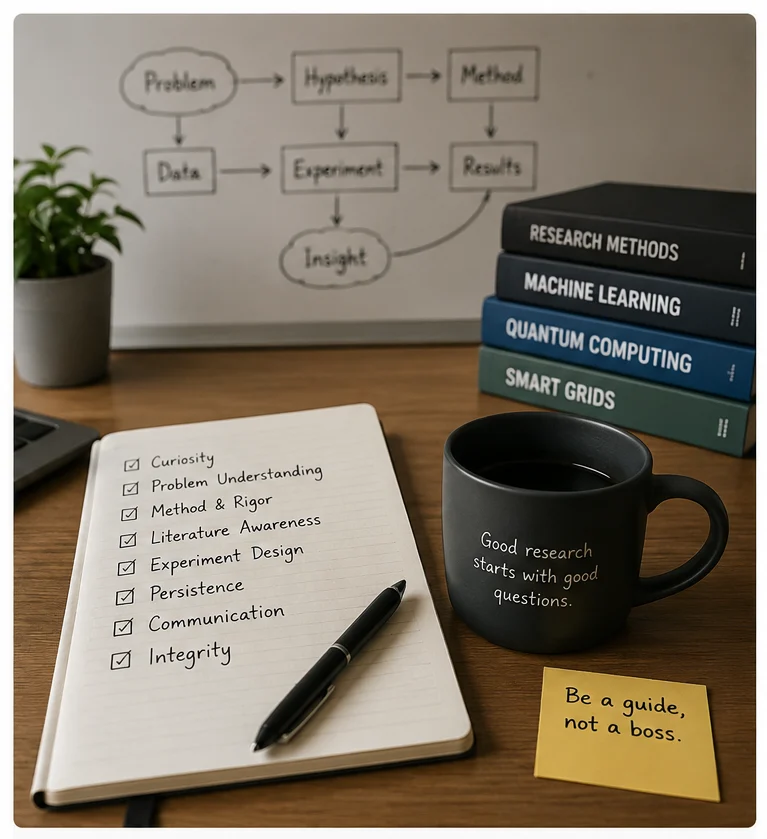
I have supervised one PhD and three master's theses to completion, plus a long tail of undergraduate projects. When a student asks to work with me, I am not really evaluating what they think I am evaluating.
What I am not looking for#
Grades. They tell me a student can do assigned work with a known answer. Research has neither of those properties.
Prior knowledge of my field. The literature can be read in a semester. Whatever a first-year student knows about quantum machine learning today will be partly obsolete by the time they submit.
Confidence. I have watched confident students stall for a year because they could not say "I don't understand this."
What I am actually looking for#
Tolerance for a null result#
Most experiments do not work. A student who can run an experiment, get nothing, and report it accurately — without inflating it, and without being crushed by it — will finish. A student who needs every experiment to succeed will start unconsciously steering their analysis, and I will spend the next two years checking their work rather than reading it.
The best answer I have ever heard to "how did the experiment go?" was:
"It didn't work, and I think I know why, and I think the reason is more interesting than the thing I was trying to show."
The ability to say "I don't know"#
Precisely and without embarrassment. There is an enormous difference between "I don't understand the paper" and "I don't understand why they use a Trotter decomposition in equation 7." The second is a research question. The first is a mood.
Something they finished#
Anything. A game, a mod, a small library, a bicycle rebuilt from parts. I do not care what it is. Finishing is a skill, it is rarer than talent, and it does not appear on a transcript.
The one thing I promise in return#
That I will tell them when their work is not good enough, early, while there is still time to fix it — and that I will be specific about why.
A supervisor who is kind at month six and brutal at month twenty-three has not been kind. They have been comfortable.